For import and compliance leads, cut flowers and young plants
Ask before you order.
Before a new line from a new origin goes on a purchase order, Twigmark tells your agent whether the EU or Great Britain lets it in on that date, what the phytosanitary certificate must state, and which act says so.
Twigmark is an API and MCP server for the plant health import rules of Regulation (EU) 2019/2072, in the EU and in Great Britain, answered by plant, origin and date and cited to the annex point.
The question your agent asks
import_requirements {
  "market": "EU",
  "plant": "Petunia",
  "origin": "Uganda",
  "commodity": "plants_for_planting",
  "date": "2026-11-29",
  "limit": 12
}
A real call, answered from the texts of 15 Oct 2026. The answer sheet shows the result, excerpted, with every value as returned.
Annex VII, 11 entries
Matched by family, SolanaceaeApplies where named pests occurAll but 21.1 apply by commodity. Each may become a line on the certificate.
- Prohibited
- Yes, Annex VI, point 181
- Derogation
- 2026/1376 in force2
14 Jul 2026 to 31 Jul 2029 - Certificate
- Required, Annex XI, Parts A and B
Collector's noteRead from the consolidated text applying from 15 Oct 2026, 02019R2072-202610153. Source: EUR-Lex, © European Union, consolidated texts CC BY 4.0. Not phytosanitary advice: the exporting country's plant protection organisation certifies and the border control post decides.
The raw answer, as JSON
{
  "summary": "Petunia (plants for planting) from Uganda into the EU on 2026-11-29: prohibited under Annex VI, point 18, but derogation 2026/1376 (to 2029-07-31) may allow it: read its conditions; 11 special requirement entries matched; a phytosanitary certificate is required.",
  "prohibited": true,
  "prohibitions": [
    {
      "ref": "Annex VI, point 18",
      "match": "family",
      "why": "Petunia belongs to Solanaceae (GBIF backbone)",
      "origin_match": "applies",
      "origin_why": "Uganda is a third country not excepted",
      "description": "Plants for planting of Solanaceae other than seeds and the plants covered by entries 15, 16 or 17 (2)",
      "derogations_in_force": [
        {
          "act": "Commission Implementing Regulation (EU) 2026/1376",
          "valid_from": "2026-07-14",
          "valid_to": "2029-07-31",
          "derogates_from": [
            "Annex VI, point 18"
          ],
          "names_your_plant": true,
          "names_your_origin": true
        }
      ]
    }
  ],
  "special_requirements": [
    {
      "ref": "Annex VII, point 21.1",
      "match": "family",
      "origin_match": "applies"
    },
    {
      "ref": "Annex VII, point 2.1",
      "match": "general",
      "origin_match": "applies"
    },
    {
      "ref": "Annex VII, point 3",
      "match": "general",
      "origin_match": "applies"
    },
    {
      "ref": "Annex VII, point 4",
      "match": "general",
      "origin_match": "applies"
    },
    {
      "ref": "Annex VII, point 4.1",
      "match": "general",
      "origin_match": "applies"
    },
    {
      "ref": "Annex VII, point 4.3",
      "match": "general",
      "origin_match": "applies"
    },
    {
      "ref": "Annex VII, point 5",
      "match": "general",
      "origin_match": "applies"
    },
    {
      "ref": "Annex VII, point 7",
      "match": "general",
      "origin_match": "conditional"
    },
    {
      "ref": "Annex VII, point 8",
      "match": "general",
      "origin_match": "conditional"
    },
    {
      "ref": "Annex VII, point 13",
      "match": "general",
      "origin_match": "applies"
    },
    {
      "ref": "Annex VII, point 30",
      "match": "general",
      "origin_match": "applies"
    }
  ],
  "special_requirements_total": 11,
  "certificate": {
    "required": "yes"
  },
  "version": {
    "applies_from": "2026-10-15",
    "celex": "02019R2072-20261015",
    "url": "https://eur-lex.europa.eu/legal-content/EN/TXT/HTML/?uri=CELEX:02019R2072-20261015"
  },
  "not_covered": [
    "Annex VIII and X (protected zones)",
    "Regulation (EU) 2018/2019 high-risk plants list",
    "emergency measures adopted as separate acts",
    "Annexes XIII and XIV (plant passports)",
    "national measures of member states"
  ],
  "caveat": "Not phytosanitary advice. The exporting country's plant protection organisation certifies, and the border control post of the importing country decides; its decision is final."
}One answer, spread over 47 acts.
The rules for one plant from one origin sit in a regulation that 31 acts have amended since 2020, and in 15 standalone acts that set it aside for named plants and origins. The derogations never enter the consolidated text. The ban that stops Petunia names a family; the act that lets it in names a country.
The moment of the call
A buyer adds a new variety from a new grower. Before the order is signed, someone has to know whether the cuttings may come in at all, and what the exporter's certificate must say. Twigmark answers that question in one call, and again whenever the rules move.
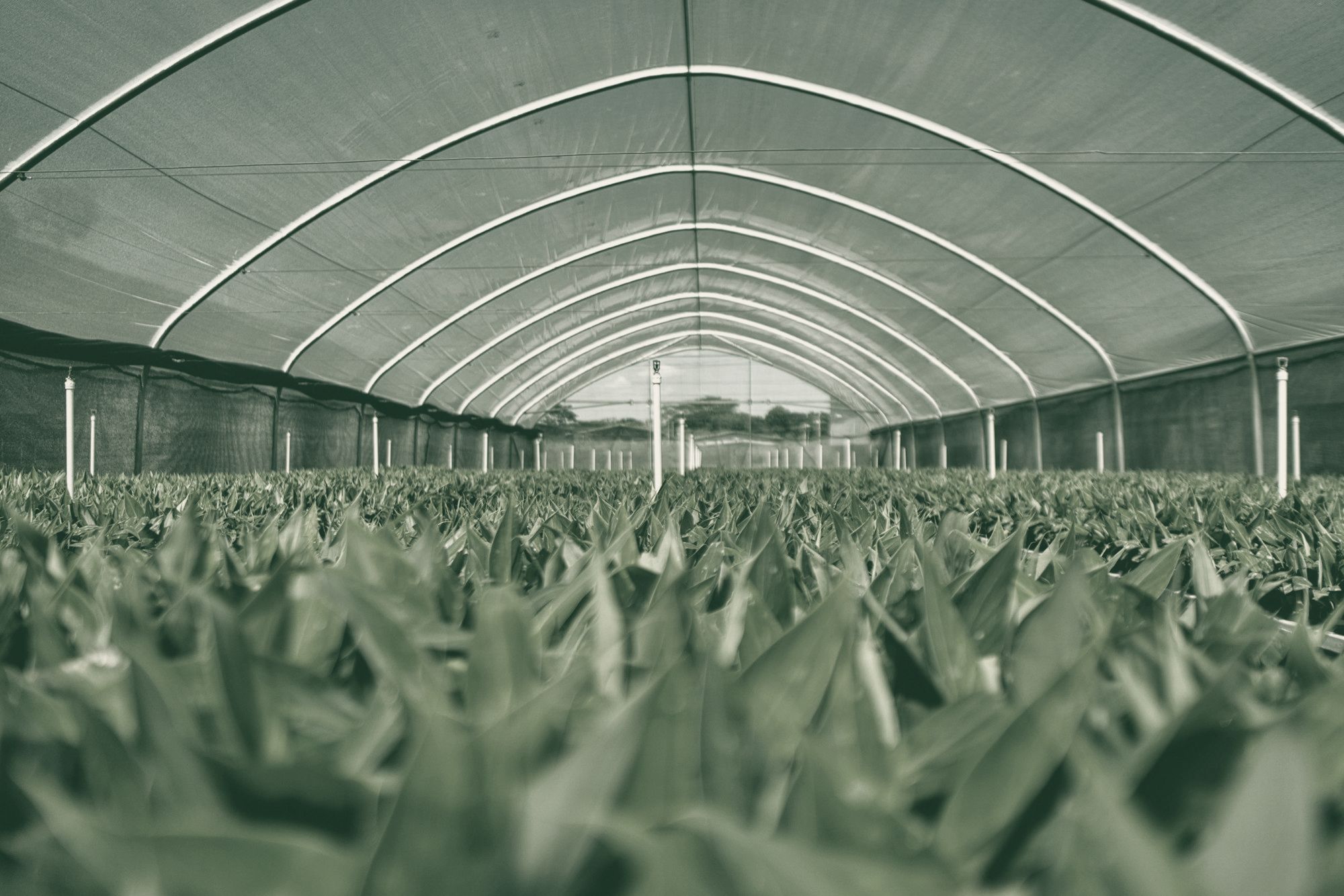
Young plants under a shade-net polytunnel. Photo: Héctor Emilio Gonzalez, Unsplash
Four joins, each one cited.
Nothing is parsed at question time, and no language model is involved. The annexes, the derogation acts and the plant families are read and checked in advance, so the answer is a lookup with a reason attached to every line.
PetuniatoSolanaceae
Plant to family
Genera of the 10 families and groups the annexes name come from the GBIF backbone. Solanaceae holds 113 of them, Petunia among them.
Ugandatothird country
Origin to rule
Countries, groups and exceptions are read into every row. A region that cannot be resolved to countries answers check, never a guess.
29 Nov 2026totext of 15 Oct 2026
Date to version
10 EU and 8 GB versions are held. A date before 26 January 2025 is refused rather than answered from a later text.
Point 18to2026/1376
Ban to derogation
The 15 standalone acts are indexed by the points they lift and the dates they run, so a prohibition arrives with its way in.
One cited answer
The answer
Prohibition, derogation, 11 Annex VII entries with the reason each matched, certificate need, version and act.
Not prohibited still carries a condition.
Cut roses from Kenya meet no ban. One Annex VII entry still decides what the certificate must say, and Great Britain files the same pest under another number.
- Prohibited
- No, no Annex VI entry matched
- Condition
- Annex VII, point 621
Rosa is named; last set by 2024/2004 - Certificate
- Required
“Official statement that: (a) the cut flowers and the fruits originate in a country recognised as being free from Thaumatotibia leucotreta (Meyrick) in accordance with the relevant International Standards for Phytosanitary Measures, provided that this freedom status has been communicated in advance…”
- Condition
- Annex 7, Part A, entry 942
Fruits of Capsicum (L.) and cut flowers of Rosa L - Changed
- 26 Apr 2025, by The Windsor Framework (Retail Movement Scheme: Plant and Animal Health) (Amendment etc.)…
- Certificate
- Required
import_requirements {"market":"EU","plant":"Rosa","origin":"Kenya","commodity":"cut_flowers","date":"2026-11-29"}Every entry, plant and act has its page.
For people searching and for the models that answer them: one stable page per annex entry, per derogation, per plant genus the texts name and per month of changes, each with the official link and a citation to copy.
What it reads, and what it leaves to you.
Every version since January 2025 is kept, so a past date is answered from the text that applied then. Each refresh is checked against fixed anchors before it replaces anything; a failed refresh keeps the previous data.
It reads
- EUR-Lex, Regulation (EU) 2019/2072Annexes VI, VII and XI in 10 consolidated versions from 26 January 2025. Newest: 22, 153 and 69 entries.
- EUR-Lex, the derogation actsThe 15 acts its table records as derogating from 2019/2072, with the points they lift and their dates.
- legislation.gov.uk, the GB textAnnexes 6, 7 and 11 at each date they changed, with 313 amendment notes. Open Government Licence v3.0.
- GBIF Backbone TaxonomyGenera of the 10 families and groups the annexes name. CC BY 4.0.
It does not cover
- EU: Annex VIII and X (protected zones)
- EU: Regulation (EU) 2018/2019 high-risk plants list
- EU: emergency measures adopted as separate acts
- EU: Annexes XIII and XIV (plant passports)
- EU: national measures of member states
- GB: GB high-risk plants list outside Annex 6
- GB: GB licences and authorisations for prohibited material
- GB: Northern Ireland
- GB: Annex 8 and 10 (protected zones)
Not phytosanitary advice. The exporting country's plant protection organisation certifies, and the border control post of the importing country decides; its decision is final.
Start with the next order.
Twenty calls a day need no account. Paid plans are for desks that check every new line and re-check open ones when the rules change.
Free
Anyone asking about the next order before it is signed, and any agent finding out what Twigmark knows. No sign-up, no key.
Pro
One importer or customs adviser checking new lines and origins, from one agent.
Desk
Fits an import deskAn import or compliance desk checking every new product and origin, and re-checking open lines when the rules change.
Platform
A customs broker or trade software vendor screening plant lines for many clients.
Prices in euros a month, excluding VAT, as set on 9 November 2026. Calls beyond a plan's limit are refused, never billed. Nothing is charged during the private preview. Machine-readable in pricing.json.
Give your agent the question.
One MCP server with five read-only tools, or the same tools over HTTP. The address below is the one intended for launch; it is not live yet.
# Claude Code
claude mcp add --transport http twigmark https://twigmark.bulkhead.solutions/mcp

# Claude: Settings, Connectors, Add custom connector
# Name: Twigmark   URL: https://twigmark.bulkhead.solutions/mcp
// .cursor/mcp.json
{
"mcpServers": {
"twigmark": { "url": "https://twigmark.bulkhead.solutions/mcp" }
}
}# ChatGPT: Settings, Apps and Connectors,
# Advanced, Developer mode, Create
# Name: Twigmark
# MCP server URL: https://twigmark.bulkhead.solutions/mcp
# Authentication: none (free tier)Free tier: 20 calls a day, no key. Coming: twigmark.bulkhead.solutions is not live yet.
curl -X POST https://twigmark.bulkhead.solutions/v1/tools/import_requirements \
  -H "content-type: application/json" \
  -d '{"market":"EU","plant":"Petunia","origin":"Uganda",
       "commodity":"plants_for_planting"}'

# Paid plans add:
#   -H "authorization: Bearer <key>"
The five tools
- import_requirementsPlant import requirements by plant, origin and date. What the EU or GB plant health annexes require for one plant from one origin country on a date: Annex VI prohibitions (with any EU derogation act in force), the Annex VII special requirement entries that apply (ref, why it matched, origin match, an excerpt; paginated with limit and offset), and whether Annex XI requires a phytosanitary certificate, plus amendments already adopted but not yet applying.
- requirement_textFull text of one annex entry. The verbatim wording of one entry of Annex VI, VII or XI as it stood on a date, with its description, origin, CN codes (EU), the act that last amended it, EU derogations in force, the dates on which it changed within the stored versions, and amendments adopted but not yet applying.
- compare_eu_gbCompare EU and GB rules for one plant and origin. Puts the EU and GB answers for the same plant, origin, commodity and date side by side and lists the differences: prohibited in one and not the other, an EU derogation with no GB counterpart in this service, certificate need, number of special requirement entries, and the organisms named only in one side's requirement text.
- derogationsEU derogation acts from 2019/2072. Lists the standalone Commission acts that EUR-Lex records as derogating from Implementing Regulation (EU) 2019/2072, including temporary measures such as those on citrus black spot (for example allowing unrooted Calibrachoa and Petunia cuttings from Uganda despite the Annex VI ban), with the annex points they derogate from, their validity dates, and whether the title names your plant and origin.
- changes_sinceAmendments and derogations since a date. What changed in the EU and GB plant import annexes after a date: amending acts and the point each touches (EUR-Lex index), derogation acts starting or ending, GB amendment notes, and entry-level text changes found by comparing stored versions, oldest first.
What is Twigmark?
Twigmark is a data service and API that tells an importer, or the import agent working for one, whether the EU or Great Britain lets a plant in from a given country on a given date, and on what conditions: the Annex VI prohibitions, the Annex VII special requirements, the Annex XI certificate need and the EU derogation acts of Implementing Regulation (EU) 2019/2072, cited to the annex point and the version of the text.
Is it official or a substitute for a phytosanitary certificate?
No. Twigmark is independent and reads the official texts automatically; no person checks each answer. The exporting country's plant protection organisation certifies, and the border control post decides. Every answer links the official text to check before acting.
Why not read the consolidated text myself?
You can, and every answer links it. Three things make it slow: entries that name a family instead of your plant (Petunia meets a ban on Solanaceae), 15 derogation acts that the consolidated text never contains, and a GB copy that has been amended on its own dates since 2021.
What does it not cover?
Emergency measures in separate acts, the EU high-risk plants list (Regulation (EU) 2018/2019), protected zones, plant passports, national measures, GB licences and Northern Ireland. Every answer lists these under not_covered.
Can an AI agent use it?
Yes, it is built for agents first: a remote MCP server, a REST API with OpenAPI and a command-line tool, five read-only tools. The free tier answers 20 calls a day with no sign-up, so an agent can try every tool before anyone pays.